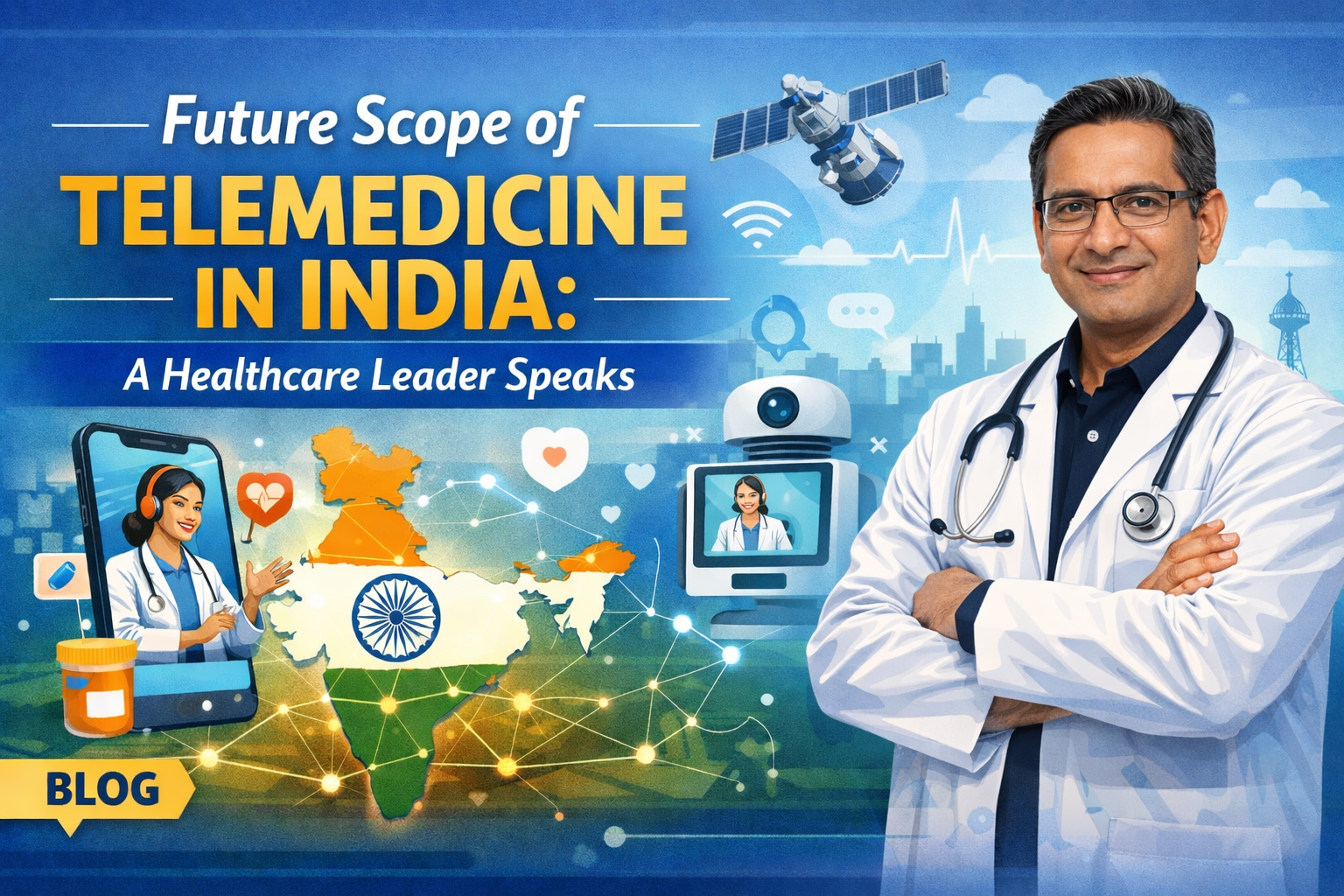
Today, when I sit in my office and am staring at a healthcare landscape that has changed in the past five years as much as it did in the past half-century, I have only one thought: we are not waiting to see what digital health in India is and is going to be; we are living in it. Telemedicine no longer represents a stopgap to a crisis that affected the entire world. Today, as a leader in this area, I would find a nation that has already overcome the developmental hurdles of traditional developments to establish a digital health superhighway. The heartbeat of Indian healthcare has now gone electronic, connected, and smarter than ever, be it the hustling metro corridors of Tier 1 or the far-flung primary health centers of the Western Ghats. The experience I went through, visiting boardrooms and clinics alike, has made me understand that the future of telemedicine in India is not on a screen; the future of telemedicine in India is on democratization of expertise.
The Dawn of a USD 4.48 Billion Digital Health Era
The digital transformation of our economy is phenomenal. Officially, the Indian telemedicine market is already a USD 4.48 billion market as we sail into 2026. It is not only a statistical breakthrough; it is also a paradigm change in the way 1.4 billion individuals communicate with their physicians. The current accelerated growth rate of more than 23 per annum is making the market through an upward trend, which is bound to take the market to a valuation of more than USD 12 billion in the year 2031. The cause of this surge is the ideal storm of cheap 5G connectivity, an unprecedented influx of smartphone penetration into even the most rural of villages, and a cultural shift in which health management is being actively taken into the hands of individuals.In the case of us who are the heads of these organizations, it is no longer about whether we can connect; it has now become how well we can care. In the early 2020s, a dependable video call was good enough. Nowadays, the discussion is dominated by mHealth mobile health applications, which comprise almost half the market share. We are heading towards the idea of the hospital with no walls, in which the home becomes the new primary care unit. This move is saving the patients billions of out-of-pocket costs, especially travel and lost wage, which has long been the biggest barrier to quality care in India.
The Ayushman Bharat Digital Mission: A National Nervous System
The Ayushman Bharat Digital Mission (ABDM) has monumental implications for the future of Indian healthcare. Being a healthcare leader, I consider ABDM as the UPI moment of medicine. Fragmented medical records are another issue that is finally being solved because we have already developed more than 73 crore Ayushman Bharat Health Accounts (ABHA). Until this digital backbone was in place, the history of a patient was usually a set of worn-out pieces of paper slips and misplaced X-rays. We are currently establishing a longitudinal health record that accompanies the patient throughout his or her life until old age.The eSanjeevani platform, which has become an element of this government-led revolution, already allows hundreds of millions of consultations. The significance of this is the assisted model. There is an increase in Ayushman Arogya Mandirs—digital bridges in the form of health and wellness centers. A remote village farmer can walk in a local center, and a community health worker with a tablet can then connect them with a specialist three hundred miles away. It is only this hub-and-spoke model that can respond to the glaring fact that though 70 percent of our people are rural, almost 80 percent of our experts are urban.
AI and the Internet of Medical Things: Beyond the Video Call
The future frontier that we are already penetrating is the deployment of artificial intelligence (AI) and the Internet of medical things (IoMT). During my meetings with technology partners, communication is no longer all that matters but rather clinical intelligence. We are also rolling out AI-based diagnostic devices that are capable of diagnosing diabetic retinopathy or tuberculosis using just an attachment to a smartphone. These AIs are minimizing diagnostic errors by up to 40 percent, offering physicians a so-called digital second opinion, as doctors are usually overworked and under-resourced. In addition, IoMT is leading to the emergence of so-called tele-homes. There is an enormous movement towards Remote Patient Monitoring (RPM). The visit once a month is not enough for a patient with chronic heart failure or diabetes. The future is in wearable gadgets, which relay real-time vital signs, ECG, blood glucose, and oxygen saturation straight to the central nurse station at a hospital. In the event the parameters of a patient do not match the norm, an AI sends warnings to the care team before a medical emergency takes place. This is the only sustainable solution to the current burden of non-communicable diseases that is increasing in India as a preventive-first approach.
Teleradiology and the Specialist Gap
Telemedicine is also most effectively used in teleradiology, which is one of the most successful applications that I have encountered on the institutional level. Teleradiology has taken over the market of clinical services, as there has been constant scarcity of specialized radiologists in India. It enables the 24/7 turnaround of important scans. A CT scan can be uploaded to a Tier-3 city trauma center at 2:00 AM and be read by a subspecialist anywhere in the world minutes later. This is literally what distinguishes life and death in emergency medicine.The same is happening with tele-pathology and tele-ICU models. A single intensivist can remotely observe dozens of beds in dozens of smaller hospitals in a tele-ICU set up. This works to the benefit of the expertise of our finest medical minds in an area that is far, far larger, and we are able to guarantee that a patient in a small-town clinic gets the same degree of critical care monitoring as a patient in a high-end metropolitan hospital.
Navigating the Challenges: Trust, Literacy, and Security
With optimism, the way up is not smooth. As a leader, the digital divide is a major issue that I am conscious of. On the one hand, internet penetration is at an all-time high; however, on the other hand, there is a serious barrier to digital literacy. It is not possible to just issue a patient with a smartphone and expect him or her to operate a complicated health application. Telemedicine in India has to be multilingual, understanding, and, most of the time, human-assisted in the future. To earn trust, we are investing significantly in so-called phygital models, which are physical centers that have digital tools.Another pillar that is going to shape the upcoming decade is data security. Efforts to comply with the Digital Personal Data Protection Act have imposed strict demands on data localization and patient consent by healthcare providers. The creation of a secure encrypted infrastructure is not a luxury anymore; it is a precondition to survive. Patients should be assured of the fact that their most confidential health information is as safe as their bank account. We are experiencing a migration towards cloud-based platforms with elastic security and compliance, enabling both startups and established hospitals to scale without security lapses on privacy.
The Rise of Tier-2 and Tier-3 Cities
The most interesting occurrence that I have been observing, perhaps, is the source of growth. Although the first stage of telemedicine was an urban event, the ongoing boom is occurring in Tier-2 and Tier-3 cities such as Jaipur, Lucknow, and Coimbatore. Such cities are also characterized by the existence of vast middle classes, who have high demands of care but are not easily able to access super-specialists. It is being reported that more than 40 percent of the business of digital health platforms is now being generated in these regions.Telemedicine is not substituting the doctor in such markets; rather, it is improving the local ecosystem. We are also witnessing hybrid models of care where a patient comes to a local GP and gets a physical exam, but a metropolitan specialist, via video, consults with the patient on the treatment plan. This team process is easing the burden of the Indian healthcare process and making it more effective and less complicated for the common family.
A Vision for 2030 and Beyond
In the future, I am dreaming of an India where the "tele" in telemedicine one day becomes non-existent and there is only medicine that is digital. We are entering a new world where all Indians will have a digital twin—a holistic profile of data that, by predictive analytics, recommends lifestyle changes before a disease has even set in. Virtual wards will arise where patients not in need of intensive care are managed at home as intensively as an inpatient and release hospital beds to the most urgent cases.
Our leadership issue today is to make sure that this technology is still human-centric. We should protect against the commoditization of the doctor-patient relationship. Technology ought to be the tool that makes the administrative white noise, the billing, the keeping of the records, and the scheduling go away and lets the doctor concentrate on the signal, the health, and the well-being of the patient.
Telemedicine has transformed the face of Indian healthcare, which is an achievement of our nation to be innovative when it matters. This is not merely our keeping up with the world; in numerous ways of digital public goods and large-scale health rollout, we are on the front line. In the coming decade, we will be searching towards even greater areas of AI integration, greater data security, and, above all, the fact that no citizen will be left behind due to their location. The future is digital, bright, and present.