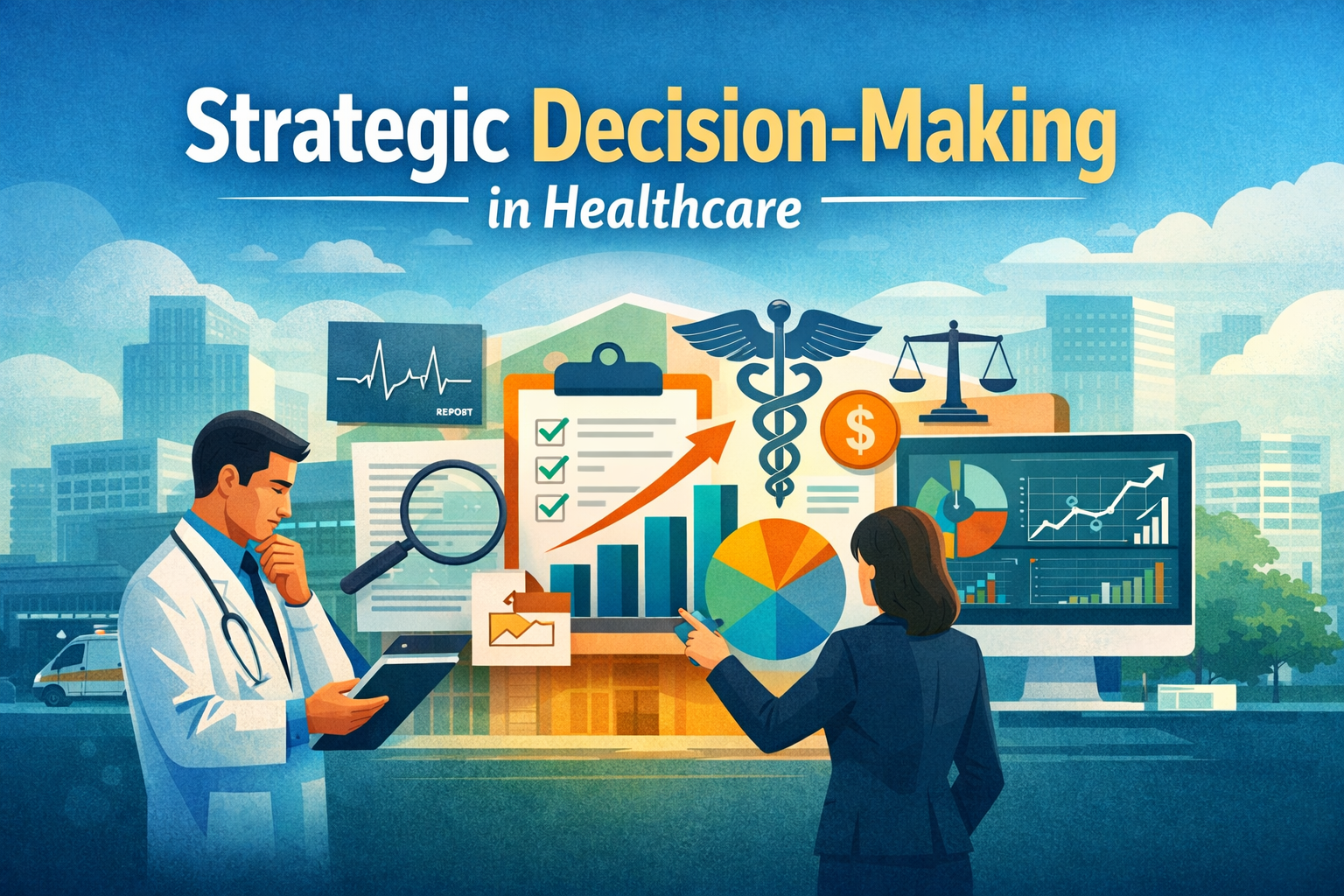
Decision-making in the modern complicated healthcare setting cannot be immediate or short-term. Health care facilities operate in highly regulated systems and changing patient demands, technology disruption, and economic limitations. Through strategic thinking, leaders are in a position to strike a balance between clinical excellence and operational efficiency and long-term growth.
Healthcare management does not need strategic decision-making to be confined to the boardroom. It has an impact on patient safety procedures, service line growth, digital investments, workforce planning, and financial governance. Organizations that incorporate strategy in their organizational operations have a higher place to succeed in competitive and highly regulated markets.
Understanding Strategic Decision-Making in Healthcare
The art of strategic decision-making is a summation of goal-setting in the long term, the process of critical evaluation of the internal and external milieus, the prudent allocation of resources, and the coordination of organizational activities to ensure the long-term sustainability of the results.
The World Health Organization is among the entities that shape the global healthcare agenda and project resilient and patient-centred systems in the future. In India, the accreditation requirements provided by the National Accreditation Board of Hospitals and Healthcare Providers presuppose organized governance, measurable performance indicators, and risk-oriented approach.
Strategic leadership ensures that such imperatives are not viewed as isolated mandates but they are embedded in holistic long-term planning mechanisms.
Aligning Quality Care with Institutional Growth
Among the most eminent issues facing both health-care management scholars and practitioners is the challenge of ensuring that the mandate of constant quality assurance is reconciled with the need to expand the service portfolios. Unrestrained growth, devoid of strong governance frameworks, leads to disorder in operations, but a too strong control apparatus kills the very creative force that is needed in the development of institutions. This delicate balance is now well understood as being able to be arranged by a wise and tactical thinking.
Health-care leaders of high order actively interrogate epidemiological data, proactive needs surveys of communities, and any gaps in their current services before they roll out adjunct specialties or increase bed capacity. Whether through strict assessment of post-discharge mortality rates, measures of quality improvement, and the calculus of cost and benefit, institutions develop a culture of responsible evidence-based expansion.
An example of such a strategic development framework, meticulously tuned so as to drive expansion and at the same time ensure a high standard of care, is the Mayo Clinic. Their roadmap is based on the integration of constant research, the use of data-based performance audits and robust architecture of governance. Therefore, strategic decisions are a winning loop and they make sure that the growth initiatives strengthen the foundations of care delivery, and not weaken them.
Data-Driven Healthcare Leadership
The modern paradigm of strategic decision-making in healthcare organizations is closely connected with the powerful data-analytic frameworks. The key performance indicators that hospital administrators regularly use to guide their management decisions include bed occupancy rates, average length of stay, patient satisfaction indexes, infection rates measures, efficiency indicators of the revenue cycle, etc.
By conducting systematic examination of these metrics, executive teams can be prepared to identify operation backlog, project demand patterns, and can allocate resources precisely. The information-based decisions thus curb the guesswork and enhance accountability in all functional departments.
The best of these organizations like the Cleveland Clinic utilizes analytics to continuously optimize clinical workflows, improve operational processes and redefine financial policies. Such a rigorous approach is a demonstration of how data-intelligence supplements the patient-care and administrative effectiveness. When healthcare institutions incorporate analytics in their strategic governance structures, they are therefore in a better place to respond to the changing market dynamics and regulatory requirements.
Financial Planning and Resource Optimization
The strategic decision refers to a critical role in financial sustainability in the long term. Health-care facilities have no choice but to struggle with rising operation costs, shifting payer mixes, and capital investment pressures.
The financial strategy is strong and includes long-term capital budgeting, strict service-line profitability evaluation, and strict cost-controlling measures, and careful revenue-cycle optimization. Fiscal planning and clinical imperatives are synchronized by leaders, which helps them protect the quality and continuity of patient care, even under economic pressure.
Redundancy, waste and increased return on investment are mitigated and curtailed by strategic resource allocation. This rigorous paradigm supports profitability and, at the same time, maintains the regulatory compliance, and quality.
Regulatory Compliance and Risk Management
The healthcare facilities are closely regulated. Strategic thinking involves institutional planning that takes into consideration compliance frameworks as opposed to dealing with them once they arise. Leaders reduce the risk exposure by foreseeing the alterations in the safety measures, accreditation, and legislative demands. Well-organized internal audits, quality committees, and governance reviews enhance preparation of compliance.
Strategic risk management involves emergency, supply chain and public health emergency scenario plans. The institutions that incorporate risk assessment in their strategic planning are resilient and continue operations during periods of uncertainty.
Digital Transformation as a Strategic Imperative
Investments in technologies should be enabled by a clearly-thought and well-thought-out strategy, and not just seduced by the new trends. Electronic health records, telemedicine websites, artificial intelligence solutions, and automatisms require a strict assessment procedure prior to their implementation.
The strategic leaders need to evaluate the compatibility of technology, examine the implications of cybersecurity, evaluate the training needs, and estimate the return on investment. The digital transformation can be implemented sustainably only in the case it is carefully adjusted to the institutional goals and patient-centred aims.
An established digital strategy increases efficiency, documentations, decreases medical errors, and facilitates scalability. Without strategic management, the introduction of technology can lead to cost increase without equivalent changes in performance.
Workforce Strategy and Leadership Development
In the modern healthcare setting, human resource is one of the most critical factors in the overall performance. Strategic decision-making architecture incorporates careful workforce planning, thorough succession management and targeted development programs.
Organisations that invest in ongoing professional growth and sound performance assessment systems always develop increased involvement in the team. This kind of investment enhances a culture of responsibility and continuous upgrading that consequently match staff competency with the changing service demand and specialization needs.
The leadership development programs can be used to create a pipeline of talented managers who have a fined tuned insight into governance, regulation compliance and quality benchmarking. The resulting positive effect of this deliberate development of managerial skill is the improvement of the operational resilience and the quantifiable increase in patient care outcomes.
Strong human capital strategy has a direct impact on patient satisfaction and stability of the processes of operation that contributes to strengthening the key pillars of quality healthcare provision.
Patient-Centered Strategy and Reputation Management
The Strategic thinking process in the healthcare industry requires a primary objective on the patient experience. Those organisations, which collect patient feedback in a systematic way, analyse outcome data in a rigorous way, and, thus, introduce service improvements, consequently, build up trust and strengthened brand image.
A patient-centred approach implies the management of communication channels, the minimization of waiting periods, the enhancement of transparency and the strict provisions of the clinical ethical standards. High patient satisfaction, in its turn, triggers institutional development through positive word-of-mouth promotion and increased credibility of the community.
The inseparability of quality care and reputation of the institution should be considered in the decision-making process. Long-term success in the industry depends on the continued convergence of the two imperatives.
Conclusion: Strategy as the Driver of Sustainable Excellence
Strategic decision-making in healthcare is not an occasional exercise; it is an ongoing leadership responsibility. Institutions that embed strategic thinking into governance frameworks achieve balanced growth, financial stability, regulatory compliance, and clinical excellence.
By aligning quality care delivery with long-term planning, healthcare leaders create resilient and scalable institutions capable of adapting to change. Strategic thinking strengthens not only operational outcomes but also patient trust and organizational reputation.
In an industry where lives and livelihoods are interconnected, strategy is not optional. It is the driving force that enables healthcare institutions to deliver quality care while achieving sustainable growth and long-term success.