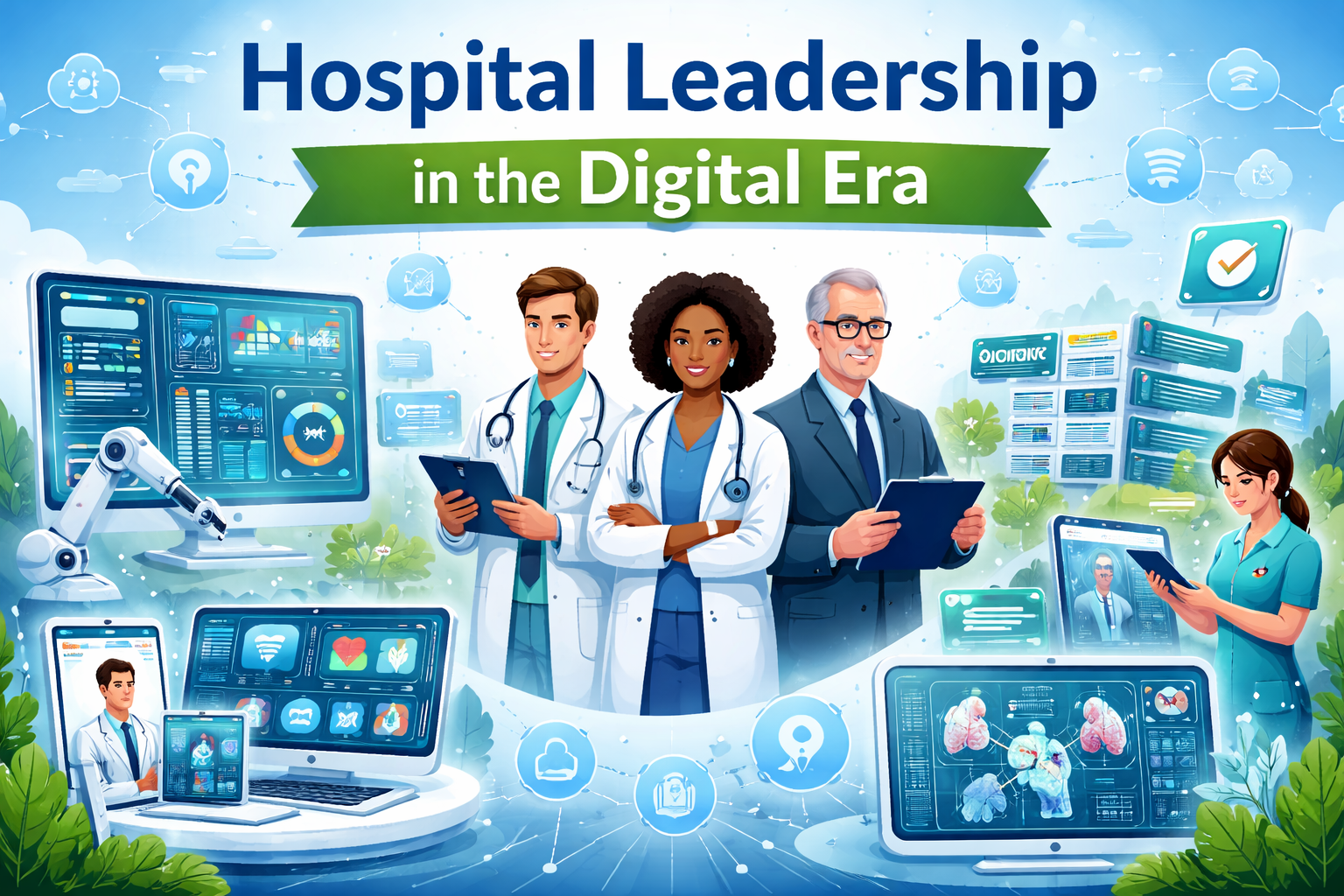
The health care industry is experiencing some of the most radical changes it has ever experienced. The digital age has transformed the paradigms of the diagnostic process, patient information handling, communication to stakeholders, and monitoring of performance in the hospitals. As such, modern hospital management has long since gone well beyond the older aspects of clinical governance and administrative control, it requires digital proficiency, information-inspired reasoning, and a technology plan that is carefully coordinated with the goals of the institution.
Digital transformation is therefore no longer a refinement choice: it is a strategic necessity that will improve the care of patients, enhance operational effectiveness, and support the long-term growth of institutions. Leaders who read and accept this paradigm shift put its hospitals at the forefront of innovation and quality excellence.
Understanding Digital Transformation in Healthcare
Digital transformation in the hospital setting concept embraces the implementation of new technologies like electronic health records, artificial intelligence, telemedicine, predictive analytics, cloud-based hospital information systems, and automation instruments in the daily workflow.
Digital health has become a central component of strengthening health systems in the global agenda that is expressed by organizations like the World Health Organization. The regulatory systems that have been developed by the National Accreditation Board of Hospitals and Healthcare Providers in the Indian context continue to encourage the use of digital documentation, quality monitoring, as well as the implementation of quantifiable performance metrics.
Therefore, the leaders of the hospital can no longer treat the concept of digitalization as a technological refinement but rather as a full-scale organisational change.
Enhancing Patient Care Through Digital Innovation
At its core, digital transformation improves patient outcomes. Electronic medical records ensure accurate documentation and continuity of care. Clinical decision support systems assist physicians in diagnosis and treatment planning. The telemedicine platforms provide a wide range of access to specialists, particularly in the underserved areas.
Digital tools reduce medication errors, enhance monitoring abilities, and enhance multidisciplinary team coordination. Patient portals adopted by hospitals make individuals access reports, book appointments and exchange information with the provider in a secure way, thus increasing transparency and patient involvement.
The examples of such institutions as Mayo Clinic show how the digital integration enhances the clinical accuracy and patient safety. They are able to constantly optimize care pathways and clinical outcomes by utilizing data analytics and protocols that are supported by research.
The leadership will play a central role in ensuring that technology does not hinder clinical workflows but augments them. Strategy management is also needed to facilitate patient-centered digital investment.
Operational Efficiency and Process Optimization
Digital transformation significantly improves the work of a hospital by incorporating new innovative technologies that facilitate everyday operations. Examples of automated billing systems include the optimization of revenue cycles, the reduction of administrative mistakes, and the acceleration of reimbursements. The inventory management software reduces the risk of low stock levels and limits the wastage. Also, data dashboards provide real-time access to the key indicators like bed occupancy, staffing, and service demand.
There is a direct impact of operational efficiency on financial sustainability. Digital tools multiply productivity in all the departments by removing unnecessary paperwork, automating the scheduling systems, and allowing faster information flow. This is in line with modern management studies where it is pointed out that organizational effectiveness is supported by use of information system.
The examples of the Cleveland Clinic and other institutions show that the analytics-based operations can raise the efficiency and quality standards. Their well-designed electronic systems enable the leadership teams to formulate evidence-based decisions that rely on real-time performance indicators, thus achieving the strategic objectives of institutions. With digital governance, hospital leaders are able to identify and implement corrective actions in seconds, thus putting their organizations in a position of a long-lasting competitive advantage.
Data-Driven Decision-Making in Hospital Leadership
In the modern digital environment, information is one of the most valuable institutional assets. Top management of the healthcare organizations is currently bending more towards advanced analytic tools to make strategic planning, risk management, and decisions on service expansion.
The key performance indicators such as the average length of stay, readmission rates, patient satisfaction indices and cost-per-case measures provides actionable information. In addition, predictive analytics create the opportunities to forecast patient demand thus enabling the hospital to optimize the number of staff and the allocation of resources.
Evidence-based governance is promoted by leadership that is based on data rather than on intuition. Strategic dashboards enable administrators to monitor changing trends, compare performance measures, and maintain accountability in divergent departments.
Digital maturity, therefore, does not only enhance clinical operations but also the decision-making ability of the executive part of the institution.
Cybersecurity and Digital Risk Management
Security of data is increasingly becoming a concern because of the digital transformation. The hospitals deal with sensitive patient data that cannot be exposed to cyber threats and illicit intrusion.
The first principle of hospital leadership in the digital era should be the sound cybersecurity infrastructure, the existence of safe data repository, and the compliance with privacy laws. Regular audits of the system, thorough employee education on data protection, and contingency planning are the main pillars of the digital governance.
Strategic leaders are well aware of the fact that risk management structures should be linked with technological advancement. Protecting digital properties also gives credibility to the institutions and maintains patient trust.
Workforce Adaptation and Digital Culture
The use of technology needs the overall cultural change in the hospitals. Digital tools cannot work without the proper training of the staff, building confidence, and their active participation during the transition process.
Leaders of hospitals should invest in constant training activities to improve the level of digital literacy of clinicians, nurses, and administrative teams. To reduce resistance and have a smooth implementation, change-management strategies are absolutely necessary.
The digital empowered workforce will increase the effectiveness of collaboration and hasten the documentation processes and improve the interaction with patients. A culture of learning is promoted by demonstrating flexibility and empowering learning by leaders, as well as encouraging a culture of innovation instead of being afraid of it.
Financial Growth and Competitive Advantage
Digital transformation has become a pillar to generate an increase in institutions, and evidence suggests that effective management of revenue cycles would lead to an increase in liquidity and budget effectiveness. Telehealth programs broaden the market reach of patients, which leads to better market penetration, and the solid data analytics can be used to identify high-volume service lines and optimize the operational performance metrics. The combination of these strengths forms a synergistic system, which supports sustainable growth.
Hospitals introducing an integrated digital ecosystem enjoy the noticeable competitive advantage in a number of essential areas. The improved quality accreditation results, increased patient satisfaction rates, and increased operational scalability are all converged to strengthen strategic market positioning. Besides, clear reporting systems and quality results that can be objectively measured will demonstrate the stakeholders with credible evidence of value and this will enhance the reputation and bargaining power of the institution. With effective investment in digital infrastructure, health care organizations can expand their services and strictly adhere to the standards of care. Hospitals can create efficiencies that eliminate overhead but do not compromise on quality by integrating technology into the fundamental clinical workflows. In the long run, these technology-based optimizations make the company financially resilient, as reflected in the falling marginal costs and the spread of revenues.
Ultimately, the integration of the digital innovation and clinical excellence creates conditions of sustainable fiscal health. Technology as a whole is constantly changing; the institutions that actively match their strategic priorities with new digital capabilities are also in a better position to remain on growth paths and to survive in volatile market forces and thus maintain their position as market leaders in the changing health care environment.
Aligning Digital Strategy with Regulatory Compliance
Governing bodies put more emphasis on accuracy of documentation, quality indicators that are measurable and hierarchical governance. Digital systems also aid compliance by ensuring that they have standardized records, trail of auditing, and performance tracking.
Heads of hospitals have to make sure that the digital platforms do not violate accreditation demands and quality models. Technology must promote the clarity of documentation and help in following up compliance.
In case digital transformation is combined with regulatory standards, institutions can be audited easier and gain greater credibility in healthcare ecosystems.
Conclusion: Strategic Digital Leadership as a Growth Catalyst
Hospital leadership in the digital era is defined by the ability to integrate technology with vision. Digital transformation enhances patient care, improves operational efficiency, strengthens compliance, and supports financial growth.
However, technology alone does not guarantee success. Strategic oversight, workforce engagement, cybersecurity vigilance, and data-driven governance determine whether digital initiatives translate into measurable outcomes.
Hospitals that embrace digital transformation as a leadership priority build resilient, scalable, and patient-centered institutions. In an increasingly competitive and technologically advanced healthcare landscape, digital leadership is not simply an advantage—it is a necessity for sustainable institutional growth.